
Helping you find the best Cryptocurrency and Blockchain websites
 The Next Web - Cryptocurrency News Sites
  (No Ratings Yet)
 Loading...
Canon has registered three new cameras with wireless certification agencies, a step that typically signals imminent announcements. Rumours point to updates across Canon’s mid-range mirrorless lineup: the EOS R8 II, EOS R7 II, and EOS R10 II. All three are expected in the second half of 2026. The most interesting is the R8 II, which This story continues at The Next Web

A growing number of professionals have started using AI tools to record every conversation they have, and the people being recorded usually have no idea it is happening. The Wall Street Journal reported this week that apps like Granola, which transcribes meetings without deploying a visible bot or announcing its presence, have made ambient recording This story continues at The Next Web

Modern electric vehicles retain an average of 97 percent of their original range after three years and 95 percent after five years, according to a new analysis by EV data company Recurrent. For a 2026 model with a rated range of 325 miles, that means roughly 309 miles would remain after half a decade of This story continues at The Next Web

Nvidia will invest $1 billion in South Korean internet company Naver to help finance an AI data center under construction in South Korea, the chipmaker announced late Friday. The funding will allow Naver to more than triple the size of the facility from 55 megawatts to 200 megawatts, with US private equity firm Brookfield agreeing This story continues at The Next Web

China’s market regulator fined Trip.com Group $765 million on Saturday after concluding that the country’s largest online travel platform abused its dominant market position. The State Administration for Market Regulation said Trip.com used its traffic allocation algorithms, platform rules and technology to restrict hotel operators from listing on competing services and to control the prices This story continues at The Next Web

Waymo has notified Uber that it plans to launch its own app in Austin and Atlanta in January 2028, ending the exclusivity arrangement that has kept its robotaxis available only through Uber in both cities. An Uber spokesperson confirmed the notice to CNBC and Bloomberg on Friday, adding that the change would also free Uber This story continues at The Next Web
OpenAI’s status page reported elevated error rates across its APIs, ChatGPT, and Codex on Saturday, marking the fourth service disruption in four days for the company. Users encountered 503 errors with the internal label “biscuit_baker_service_me_circuit_open,” which prevented requests from reaching OpenAI’s servers. The company moved from investigating to monitoring within an hour, saying it had This story continues at The Next Web
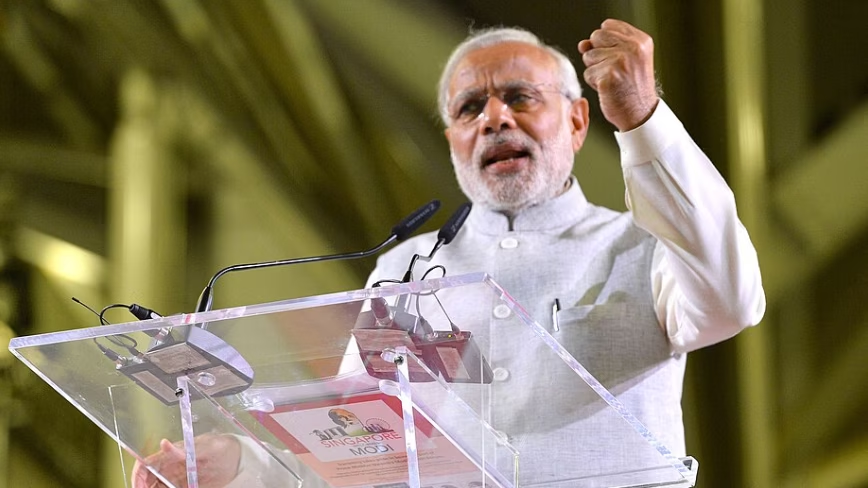
Indian Prime Minister Narendra Modi posted two selfie videos on Instagram as student protests swept the country, with the first Reel drawing more than 300 million views in 24 hours and breaking the platform’s record for a single clip. The 75-year-old leader recorded the videos late Thursday and Friday, choosing the short-video format most popular This story continues at The Next Web

Samsung Electronics and Broadcom have signed a memorandum of understanding worth more than $200 billion spanning memory chips, foundry manufacturing and advanced packaging for artificial intelligence semiconductors. The deal, announced on Friday at an AI summit in San Francisco, runs for five years through 2030 and covers some of the most critical layers of the This story continues at The Next Web

A UK employment tribunal has ruled that forcing a remote worker with anxiety, ADHD, and autism to turn on her camera during a video training session amounted to disability discrimination. Laura Tait, a home-based travel consultant at Holiday Extras, was awarded compensation after the Croydon tribunal found the company failed to make reasonable adjustments for This story continues at The Next Web


